• About Us
  • Contact Us
  • Class Schedule
  • Make an Appointment
  • Membership
  • My Account
  • My Cart
  • Log in
  • Help
Home

Clinical Somatics

The future of health...NOW
  • About
    • Welcome
    • Introduction
    • Articles
    • Testimonials
    • Practitioners
    • Options & Resources
  • Clinics
    • Welcome
    • Services
    • Locations
    • Class Schedule
    • About Our Clinics
  • Products
    • Welcome
    • Browse
    • Movement
    • Yoga
    • Pro/Medical
    • Info & Advice
    • Help/Service
  • Training
    • Welcome
    • Program
    • Testimonials
    • About
    • Admissions
    • Resources
    • Student Life
    • Alumni
  • Community
    • Welcome
    • News
    • Events
    • Library
    • Forums
    • Ask the Experts
    • Support
    • Resources

Catalog

  • Exercise/Movement Audio & Video
  • Somatics Books & Info
  • Yoga & Somatic Yoga
  • Tai Chi & Martial Arts
  • Pillows, Chairs, & Ergonomics
  • Practitioner Tools & Resources
  • Anatomy, Medical, and Health References
  • Classes & Workshops
  • Membership
  • Clinic
  • Training

Browse

  • Catalog
  • Wish list
    • Find a wish list

Shopping cart[]

There are no products in your shopping cart.

0 ItemsTotal: $0.00
Home » Catalog » Tai Chi & Martial Arts

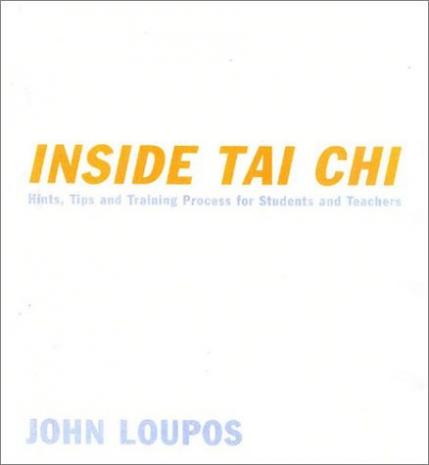
Inside Tai Chi: Hints, Tips, Training & Process for Students and Teachers

  • View
  • Reviews
  • Add review
BK-5041.jpg
$20.95

Preparing you for what to expect in your Tai Chi journey, this book offers practical advice, observations, and training exercises for anyone on the path. Sifu John Loupos began studying martial arts in 1966. As a young teen, John inherited a school of his own and has been teaching martial arts ever since. His repertoire of studies includes Okinawan Karate along with several Chinese Kung Fu systems including Bak Sil Lum, Choy Lay Fut, and Praying Mantis, plus Yang style T'ai Chi Chuan (108 move set), Liu He Ba Fa, Xingyi, and Bagua. John also practices and teaches Ch'i Kung and energy oriented meditation disciplines.
He holds a B.S. in Psychology and has a background in Classical Homeopathy and Clinical Somatics. John specializes in T'ai Chi Chuan as an inter- and intra-personal communication modality, and enjoys traveling to conduct seminars for educational institutions and corporate entities, as well as for other schools. He currently lives at the shore in Hull, Massachusetts and busies himself with writing and teaching at his main school, Jade Forest Kung Fu/T'ai Chi/Internal Arts in Cohasset, Massachusetts plus two branch facilities.

Price: $20.95
Weight: 1 lb.
SKU: BK-5041
Dimensions: 7.2in. × 0.6in. × 9.1in.
Publication Details
Pages: 
220
Language: 
English
Publisher: 
YMAA Publication Center
Publication Date: 
May 25, 2002
ISBN-10: 
1886969108
Editorial Reviews: 

Inside Tai Chi: Hints, Tips, Training & Process for Students and Teachers

Product Reviewed: 
Inside Tai Chi: Hints, Tips, Training & Process for Students and Teachers
Author:John Loupos
Publisher:YMAA Publication Center
ISBN:1886969108
Pages:220
Price:$20.95
Synopsis:

Preparing you for what to expect in your Tai Chi journey, this book offers practical advice, observations, and training exercises for anyone on the path.

Review:

Review from Journal of Asian Martial Arts, Vol 12, Number 1 - 2003.

There are already a significant number of Tai Chi books, which show the aspiring student how to do Tai Chi. Add to this the number of how to videos, audio tapes, and CDs, and there might be those who wonder at the need for a teacher at all, let alone another book.

John Loupos does not add to the crowd in his recently published Inside Tai Chi. His book is not another "how to" book (although a fair amount of space is devoted to various rooting and breathing exercises), but is more concerned with the application of Tai Chi to life in ways other than the martial. Any book that promotes this kind of application is to be applauded, as we should be encouraged to apply the principles inherent in Tai Chi as much as possible. The late Dr. Chi Chiang-tao, when asked how much we should practice, replied simply, 24 hours a day.

Loupos, similarly, would encourage us to apply Tai Chi's physical lessons, such as improved posture and physical relaxation, to our daily life, but also to use the principles developed through our increased understanding, in resolving conflict, changing our perspective on our live, and our inter-personal relationships. As is the case with many authors, Loupos reveals a lot about himself by how he writes as well as what he chooses to write about. He is a Tai Chi and martial arts teacher of many years experience, and comes across as a competent teacher and very decent human being. Mr. Chiba, one of the great Aikido teachers, was once asked what was the most important quality in a student of the martial arts. His answer was sincerity, the quality that pervades Loupos' writing.

The book imparts a body of knowledge which the author believes is important for the student's development and understanding of principles such rooting, energy/qi awareness, and self-awareness. While it is difficult to criticize the content, the style of writing may not be universally welcomed, as the language and tone have much in common with popular psychology books. Loupos' background in psychology has clearly influenced his approach to Tai Chi and also his writing.

The book really comes alive, however, when the author recounts from his considerable experience as student and teacher of several martial art systems with various teachers. I found the Preface giving a fleeting biography fascinating and would like to have seen this developed further. While respecting an authors right to privacy, it it my preference to follow a personal account of successes, failures, and insights along the "great way."

Much of the book is aimed at helping the student deal with the difficulties encountered in life. He is an advocate of using the well-known Tai Chi practice of rooting as an aid to dealing with stressful situations at the time of occurrence. He extends the use of Tai Chi beyond simply a rebalancing exercise, for use once or twice a day, toward a method to deal with the potential stressor at its source. Stressful situations do not convenience us by occurring at times when we can nip out to do a form, and so, a method which can be applied instantly and in all situations is very important in controlling our reactions to threatening situations. As Loupos put it, What emotional rooting can do is help you avoid getting stuck with the stress-causing emotions that others may direct your way.æ For many of us, this type of self-defense is needed in today's environment more than physical self-defense.

Loupos invites reflection on another interesting Tai Chi related topic when he argues, very persuasively that we ourselves determine what we perceive as conflict. He believes that the universe is always in harmony and that what we might regard as conflict can more accurately be described as "opposing," rather than conflicting forces. These forces ebb and flow but remain in balance and therefore, according to Loupos, the only "real" conflict in the universe exists in the hearts and souls (and bodies) of man, and then only because we make it so.

This is more than just a semantic debate. It reaches into the area of thought which suggest that how we experience life will be determined, at least to some extent, by how we perceive it. As the saying goes To a hammer, everything looks like a nail. Loupos goes a little further in this discussion by suggesting that free will is, in his own words, the operative factor in determining whether any two forces are opposite or conflicting. Loupos is opening up the possibility of using Tai Chi to help us change our perspectives on what conflict is, and so, change our attitudes in our daily life. This is once again a crucial area of Tai Chi practice which may not be obvious but well worth exploring.

Loupos also enter the debate on whether or not the practice of Tai Chi can make someone a better human being. There are of course problems in defining what exactly it means to become a better human being, there are well respected figures on both sides of the debate, but Loupos clearly feels that it is possible and the impression given is that, he himself, is committed to practice what he preaches in this direction.

In the final chapter, Lectures and Musings, he discusses a number of related topic and ideas which are of interest to those who practice and teach Tai Chi. What, for instance, shall we wear on our feet while practicing, at what age should children begin attending classes, and how Tai Chi affects bone density as we grow older.

In sum, Mr. Loupos has written a book which invites us to broaden our view of what Tai Chi is. As he says, Sometimes Tai Chi is just about Tai Chi, and sometimes Tai Chi is about everything.

How true!

—Jan Kauskas, M.A. Glasgow Univ.
  • Login or register to post comments
  • Printer-friendly version
  • send to friend

Inside Tai Chi: Hints, Tips, Training & Process for Students and Teachers

Product Reviewed: 
Inside Tai Chi: Hints, Tips, Training & Process for Students and Teachers
Author:John Loupos
Publisher:YMAA Publication Center
ISBN:1886969108
Pages:220
Price:$20.95
Review:

Review from September 2002 issue of Spirit of Change Magazine.

The most widely practiced martial arts/health care system in the world, Tai Chi is regarded in China as an official exercise and a national treasure. In reading Inside Tai Chi, we are offered a piece of that great wealth starting with an introduction to the fundamental principles of tai chi: relaxing the breath, relinquishing stress, improving your posture, and feeling your connection to the Earth. The strong, friendly voice of the narrator offers expert knowledge about the training of attention, awareness of bodily energy and stillness-in-action fostered by this art.

Obviously a dedicated teacher, John Loupos also comes across as a wise and caring friend, sharing his knowledge of the yang (technical expertise of the form) and yin (internal energetic experience) aspects, as well as his own story in coming to practice and teach Tai Chi. The early chapters explain how our bodies can become more resilient and less vulnerable to injury, with enhanced efficacy of our immune system, making us less susceptible to illness while maintaining and restoring our youthful vitality. We learn how Tai Chi also serves to reduce stress, beginning with improving our flexibility by relaxing, rather than stretching, the muscles. Among other valuable skills offered are mindful breathing, pushing without pushing, relaxing effortlessly into standing postures, displacing negative emotions, and opening ourselves up to heartfulness and freedom. Loupos suggests that we employ visualization techniques in rooting ourselves, so this more direct and deliberate connection with the Earth can soothe our souls and afford us some sense of sanity.

Though some of the more advanced sections may be of greater interest to the Tai Chi aficionado or teacher, the information about our bodies and their possible "right alignment" is fascinating for anyone interested in good health, balance, and well-being. The last few chapters attest to the healing wisdom of this age-old system for promoting well-being as teenaged, middle-aged and elder practitioners offer their personal stories of the physical and psychological benefits of Tai Chi.

For anyone interested in a practical, thoughtful and uniquely accessible view of this adjunctive natural healing therapy, Inside Tai Chi is the book to read.

—Heidi Rain
  • Login or register to post comments
  • Printer-friendly version
  • send to friend
  • Login or register to post comments
  • Printer-friendly version
  • send to friend

Copyright © 1995–2008, Somatic Systems Institute. Terms of Use | Investors | Invite | Site Map | Home